North Carolina Lease Disclosures for Raleigh Landlords: The Lease-Document Updates to Make Before the 2027 Lease Year

A north carolina lease agreement has no single state-mandated disclosure form, but it does have to carry a specific set of clauses to be fully enforceable: the federal lead-based paint disclosure and Lead Warning Statement for any home built before 1978, a security deposit clause that matches the Tenant Security Deposit Act, a late fee that stays inside the statutory cap, and a fee schedule that leaves out charges North Carolina treats as void. Everything else is drafting preference. This post is about the document itself - the paragraphs to rewrite before your next Wake County lease goes out the door.
Why September is the drafting window
Most Raleigh and Wake County leases signed from October forward run twelve months, which means the clauses in the document you hand a tenant next month are the clauses you will be living with deep into 2027. If a fee provision is wrong, you don't discover it when you sign - you discover it in small claims court fourteen months later, when a magistrate strikes it.
September is the cheap month to fix that. Nothing is pending, nobody is moving, and a lease template edit costs you an hour instead of a judgment.

What your NC lease must contain
| Lease element | What the document needs | Source |
|---|---|---|
| Lead-based paint disclosure | Lead Warning Statement, landlord's knowledge statement, list of records provided, tenant acknowledgment, signatures and dates - pre-1978 housing only | 42 U.S.C. 4852d; 24 CFR 35.92(b) |
| EPA pamphlet | "Protect Your Family From Lead in Your Home" given before the tenant is obligated | 24 CFR 35.88(a)(1) |
| Security deposit amount | Not more than 2 weeks' rent (week-to-week), 1.5 months (month-to-month), 2 months (longer terms) | G.S. 42-51(b) |
| Deposit location notice | Bank name and address, or bonding insurer's name, in writing within 30 days of lease start | G.S. 42-50 |
| Late fee | Only if 5+ calendar days late; greater of $15 or 5% of monthly rent; once per late payment | G.S. 42-46(a), (b) |
| Eviction-related fees | Only one of complaint-filing, court-appearance, or second-trial fee, at the statutory percentages | G.S. 42-46(e)-(h) |
| Insurance requirement | No designated carrier or agent; admin fee capped at $50/year | G.S. 42-46(l) |
| Alarm battery duty | Written agreement if the tenant is to handle batteries during the tenancy | G.S. 42-42(a)(5), 42-43(a)(7) |
| Repair notice method | Written notice from tenant for non-emergency repairs | G.S. 42-42(a)(4) |
| Pet fee | May be a reasonable, nonrefundable fee - draft it as a fee, not a deposit | G.S. 42-53 |
Clause by clause: what to update before the new lease year
1. The lead-based paint disclosure
This is the single largest liability in a nc residential rental agreement, and it is also the one most often handled sloppily. For any dwelling built before 1978, federal law requires four things before the tenant is obligated under the lease: the EPA pamphlet, disclosure of any known lead-based paint or hazards, copies of any records or reports you actually have, and a Lead Warning Statement either attached to or inserted into the lease.
The lessor's warning language is prescribed word for word. It is not the same paragraph used in sales contracts, and swapping the two is a common drafting error. There is also no ten-day inspection period for renters - that requirement applies to purchasers only, so a lease that promises tenants ten days is giving away something the rule never asked for.
Use the EPA's sample Lessor's Disclosure of Information form as your lease addendum rather than a rewritten version, keep every signed copy for three years from the start of the leasing period, and remember that if you deliver disclosures electronically you need the tenant's E-SIGN consent and a clear statement of their right to paper copies.
A knowing violation of the disclosure rule makes you jointly and severally liable to the tenant for three times the actual damages, plus court costs, reasonable attorney fees, and expert witness fees. Separately, it is a prohibited act under the Toxic Substances Control Act carrying civil money penalties, and violators may face civil and criminal sanctions. Managing agents share the compliance duty - a property manager is required to ensure the landlord complies.
For the full picture of what regulators expect, the EPA and HUD Lead-Based Paint Disclosure Rule fact sheet is short and worth reading once a year.
2. The security deposit clause
Two separate things live here, and most templates only get the first one right.
The amount is capped: two weeks' rent for week-to-week, one and a half months for month-to-month, two months for anything longer. If your lease says "two months' security deposit" on a month-to-month tenancy, that clause is over the line.
The location is the part leases forget. Deposits must sit in a trust account with a licensed, federally insured depository or trust institution authorized to do business in this state, or be backed by a bond from an NC-licensed insurer. Within 30 days after the lease term begins, you or your agent must tell the tenant in writing the name and address of that bank, or the name of the bonding company. Build the notice into the lease itself or into a signed lease addendum so it is impossible to skip.
Also tighten what you say about deductions. Permitted uses are a closed statutory list - unpaid rent and covered utilities, damage beyond normal wear, losses from nonfulfillment of the term, liens from the tenant's occupancy, re-renting costs including reasonable broker commissions, removal and storage after summary ejectment, court costs, and fees allowed by statute. A lease that reserves the right to deduct "any charges the landlord deems appropriate" is inviting a fight you will lose.
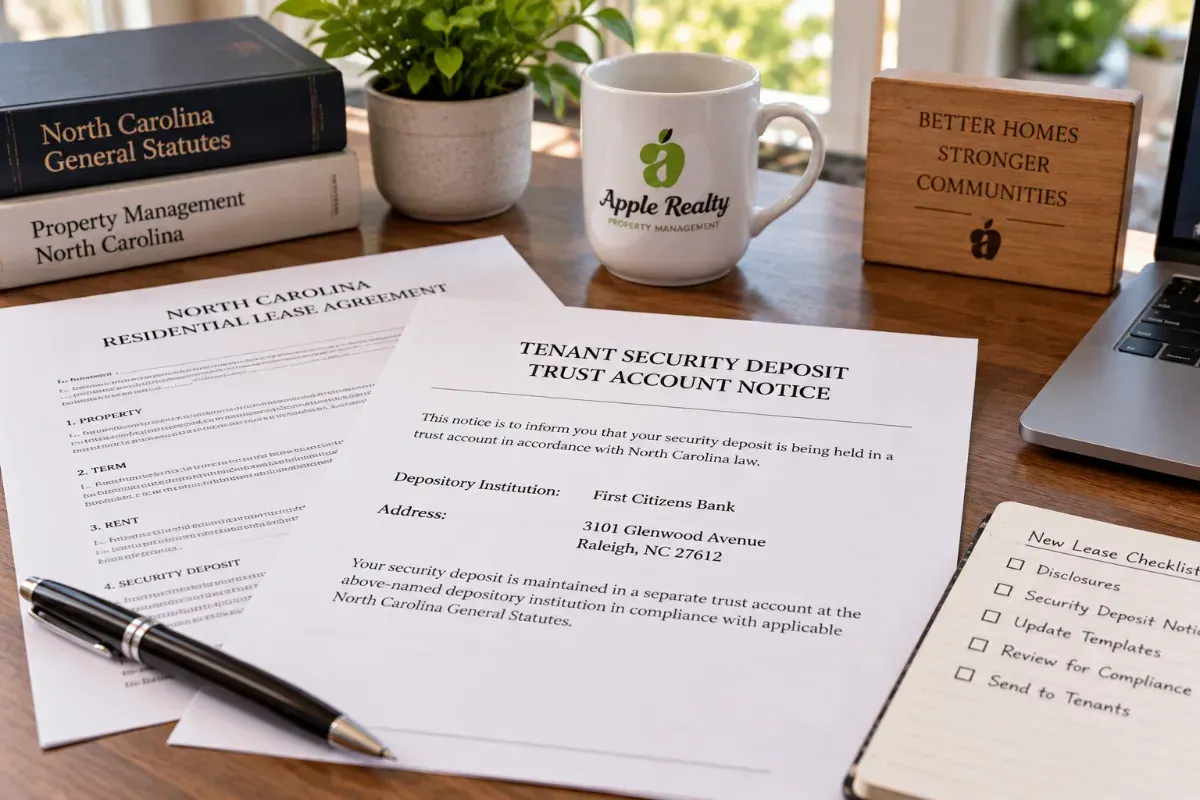
Willful failure to comply with the deposit, bond, or notice requirements voids your right to retain any part of the deposit - even for damage you can prove. The notice is the cheapest paragraph in the lease and the most expensive one to omit.
3. Late fees and the rest of the fee schedule
Rewrite this section from the statute rather than from your old template. Under N.C.G.S. 42-46, a monthly late fee cannot exceed the greater of $15 or 5% of the monthly rent, cannot be charged until the payment is five calendar days or more late (counting the day after rent was due as day one), and may be imposed only once for each late payment. You also cannot apply a late fee against the following month's rent in a way that pushes that month into default, and you cannot charge a late fee because the tenant didn't pay for water or sewer service.
The eviction-related fees are similarly bounded: a complaint-filing fee at the greater of $15 or 5% of monthly rent, a court-appearance fee at 10% of monthly rent, or a second-trial fee capped at 12% - and you may charge and retain only one of the three per action. Any other administrative eviction fee written into a lease is contrary to public policy. On subsidized units, every one of these fees is calculated on the tenant's share of the contract rent only.
Actual out-of-pocket costs are separate and recoverable: court filing fees, service of process, and reasonable attorneys' fees actually paid or owed under a written lease, capped at 15%.
A 2025 amendment added a new subsection governing leases that require tenant insurance. You cannot name the carrier or the agent. You may charge the actual cost of coverage you obtain plus an administrative fee of no more than $50 per year, and only after the tenant fails to produce proof within three business days of your request. Templates written before mid-2025 almost always need this paragraph replaced.
4. Alarms, maintenance notice, and habitability
Your repair duties come from N.C.G.S. 42-42, and two of them are drafting opportunities. Non-emergency repairs to electrical, plumbing, sanitary, heating, ventilating and air conditioning systems are triggered by written notice from the tenant- so say plainly in the lease how and where written notice is delivered. And unless the lease contains a written agreement to the contrary, you are responsible for putting fresh batteries in battery-operated smoke and carbon monoxide alarms at the start of each tenancy while the tenant replaces them during the term. That "written agreement to the contrary" only exists if you write it.
What you cannot do is draft around the duty itself. A tenant's acceptance of substandard conditions - before, during, or after signing - does not release you, so any waiver-of-habitability clause in your template is dead weight that makes the rest of the document look unreviewed.
5. Naming the landlord and the notice address
North Carolina does not impose a general statutory duty to name the property owner in a residential lease, and the statute expressly protects a managing broker or firm from personal liability in a landlord-tenant suit merely because the rental agreement doesn't identify the landlord. That is a shield, not a strategy. Give the tenant a clear, current address for notices anyway - you want an unambiguous record of where a repair request or termination notice had to go.
What's actually local in Raleigh and Wake County
Less than owners expect. Raleigh's Rental Dwelling Registration program was dissolved effective January 1, 2017 after the General Assembly removed municipalities' authority to run rental registration programs. There is no city lease-form requirement layered on top of state law here.
That cuts both ways. With no registration checkpoint, nothing external catches a defective lease - the document is the compliance program. Local codes still apply to the condition of the property, and federal disclosure rules are unaffected by state or local law, so the pre-1978 housing stock inside the Beltline and across older Wake County neighborhoods carries the same lead obligations it always has. Owners we work with through property management in Raleigh, NC tend to be surprised by how much of their exposure sits in two or three paragraphs, and the same pattern holds for Durham property management portfolios a few miles up the road.
Your September document checklist
Pull your current template and mark it up in this order: confirm the lead paint addendum uses the lessor language and is attached to every pre-1978 lease; add or correct the deposit location notice; reset the late fee to the statutory formula and delete any eviction fee that isn't one of the three allowed; replace the insurance paragraph; write the alarm battery agreement; state the written-notice address for repairs; and strike any habitability waiver. Then date the template so you know next September which version you were using.
This article is general information for rental property owners, not legal advice, and it is current as of September 2026. North Carolina fee and disclosure rules have been amended repeatedly in recent sessions, so have a licensed North Carolina attorney review your final lease before you use it.
Apple Realty writes, updates, and administers leases for owners across Raleigh, Wake County, and the Triangle - including the disclosures and deposit handling that trip up self-managing landlords. If you'd like us to look at your current document before the new lease year, reach out and we'll walk through it with you.
Frequently Asked Questions
Does North Carolina require a written lease?
No. North Carolina recognizes oral tenancies, and Chapter 42 rights attach the moment a rental agreement exists or rent is accepted. But several of the fees you probably want to charge - late fees, complaint-filing fees, court-appearance fees, insurance administrative fees - are only chargeable pursuant to a written lease. Without the document, you lose them.
What disclosures are required in an NC lease agreement?
Federally, the lead-based paint disclosure and Lead Warning Statement for any dwelling built before 1978. Under state law, the landlord or agent must tell the tenant in writing, within 30 days of the start of the lease term, where the security deposit is held - the bank's name and address, or the name of the bonding insurer. North Carolina does not impose a general mold, flood, or move-in condition disclosure form by statute.
Do I need a lead based paint disclosure form for a 1975 Raleigh rental?
Yes. Any target housing built before 1978 triggers the rule unless a narrow exemption applies - leases of 100 days or less with no renewal, certified lead-free housing, zero-bedroom units, or housing for the elderly or people with disabilities where no child under six is expected. A 1975 house does not qualify for any of those.
How much can a North Carolina landlord charge as a late fee?
For rent due monthly, the greater of $15 or 5% of the monthly rent, and only once the payment is five calendar days or more late (counting from the day after rent was due). It may be charged only once per late payment, and it cannot be deducted out of the next month's rent so as to push that month into default.
Where does a North Carolina security deposit have to be held?
In a trust account with a licensed, federally insured depository or trust institution authorized to do business in North Carolina, or the landlord may instead furnish a bond from an NC-licensed insurer. Deposits may sit in an out-of-state trust account only if the landlord provides the tenant an adequate bond in the amount of the deposits.
What happens if I never send the security deposit bank notice?
Under G.S. 42-55, a landlord's willful failure to comply with the deposit, bond, or notice requirements voids the right to retain any portion of the deposit. A missing one-paragraph notice can cost you the entire deduction at move-out, plus possible attorney's fees.
Can I make my tenant buy renters insurance through a company I choose?
No. A 2025 amendment to G.S. 42-46 says a tenant required to carry insurance cannot be forced to use a designated carrier or agent. You may charge the actual cost of coverage you buy plus an administrative fee of up to $50 per year, and only if the tenant fails to show proof within three business days of your request.
Should I use a lease addendum or rewrite the whole lease?
Both, in different places. Disclosures that must be signed and retained separately - lead paint most of all - belong in a dedicated lease addendum so they can be produced on demand. Fee caps, deposit language, and maintenance notice provisions belong in the body of the lease, because that is where a magistrate will look first.