Renting vs. Buying in the Triangle: Which Makes Sense in Durham's 2026 Market?
This article gives general information and a decision framework for the Durham/Triangle market as of July 2026. It isn't financial advice. The figures are market snapshots that move over time, run the numbers for your own situation, or talk to a local agent and lender before deciding.
"Should I keep renting, or is it finally time to buy?" In the Triangle, that question got more interesting in 2026. Home prices cooled slightly, mortgage rates settled into the mid-6% range, and rents stabilized. There's no universal right answer, but there is a clear way to think it through. Here's how renting and buying stack up in Durham right now.
Where Durham's market stands in 2026
A quick snapshot of the local numbers (which shift, so treat them as a starting point):
- Median home value: roughly the low-to-mid $400,000s, down slightly year over year, with prices forecast to appreciate about 2%-4% in 2026.
- Mortgage rates: the 30-year fixed has hovered around 6.0%-6.9%, depending on the week and your credit.
- Median rent: commonly cited in the $1,400-$1,700 range depending on bedroom count and source.
The headline: Durham is closer to a balanced market than the frenzy of a few years ago, which gives both renters and buyers more breathing room. See current figures on Redfin: Durham, NC housing market data.
The monthly cost comparison
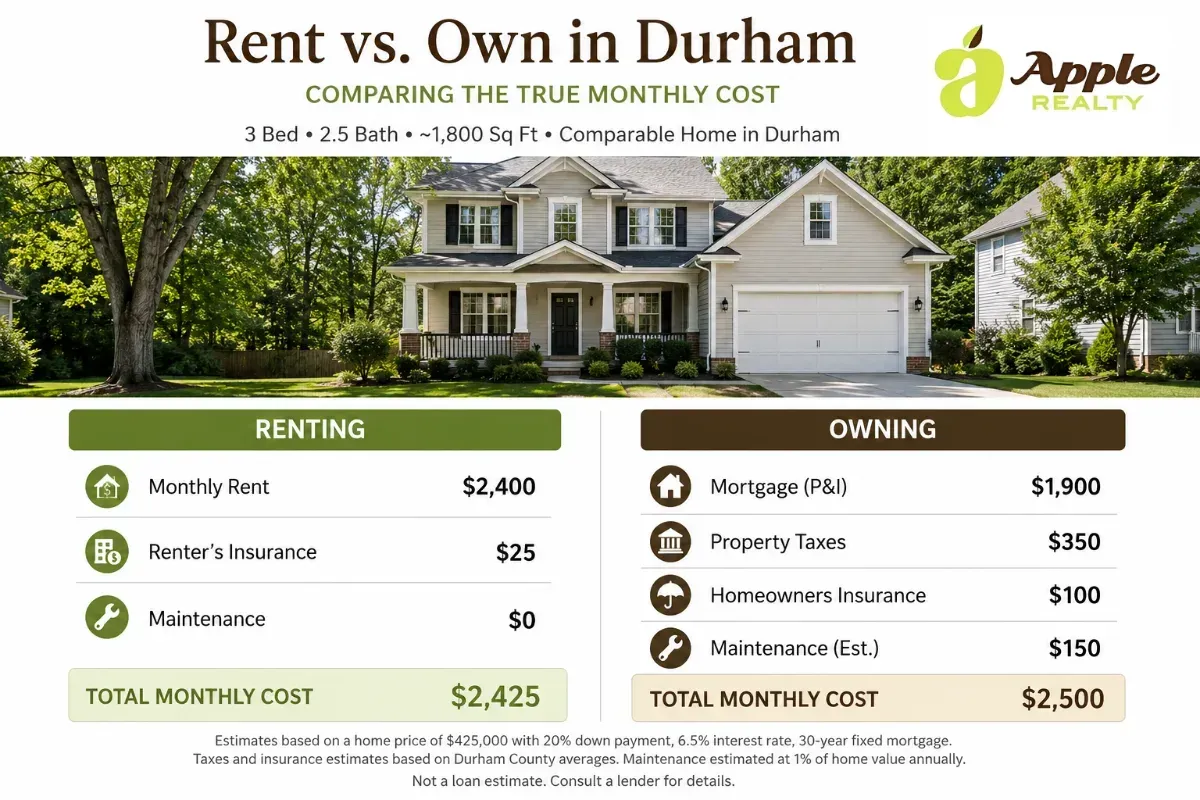
In the near term, the math often favors renting in 2026. A comparable home bought at today's rates, with taxes, insurance, and maintenance layered on, frequently costs more per month than renting the same kind of property. Several 2026 analyses of the Durham area put the monthly cost of renting several hundred dollars below the cost of owning a similar home.
That gap exists because higher mortgage rates inflate the financing portion of a purchase. But "more expensive each month" isn't the whole story, because part of a mortgage payment builds equity you keep.
The long game: equity and the break-even point
Buying tends to pull ahead over time for three reasons:
- Principal paydown — each payment chips away at the loan, converting cost into ownership.
- Appreciation — even a modest 2%-4% annual rise on a $400,000 home adds real value.
- Stability — a fixed-rate payment doesn't climb the way rent can.
The catch is upfront cost. Down payment, closing costs, and the friction of buying and later selling are large, so they need time to amortize. That's why the 5-year mark is a common break-even guideline. Stay longer and buying usually wins; move sooner and renting often does.
Ask yourself: (1) How long will I realistically stay? (2) Do I have a stable down payment and steady income? If the honest answers are "5+ years" and "yes," buying deserves a serious look. If either is shaky, renting is the lower-risk choice for now.
When renting makes more sense
Renting isn't "throwing money away", it's buying flexibility and offloading risk. It's usually the better call when:
- You might move within a few years for work, school, or family
- You want predictable costs and no surprise repair bills
- You're still building savings or credit before a purchase
- You prefer to let a landlord handle maintenance
If that's you, our renter resources hub and current available rental properties are the place to start. (Saving toward a purchase while you rent? Improving your credit and cash reserves now makes the eventual jump to buying much smoother.)
When buying makes more sense
Buying tends to win when:
- You plan to stay 5+ years in the home or area
- You have a stable down payment and reliable income
- You want to build equity and lock in a fixed payment
- You value control over the property (renovations, pets, customization)
If you're leaning this way, our team can guide you through buying a home in Durham , and the Consumer Financial Protection Bureau: buying a house tool is a great neutral primer on the mortgage process.
A third option: buy now, rent it later
Some Triangle households split the difference, buy a home they can grow into, and keep flexibility by renting it out if they relocate. If that's on your radar, it helps to understand how property managers charge in Durham and what's involved in operating a rental. And if you already own and are weighing your options, we can help with selling your Durham home or converting it to a rental.
The bottom line
In Durham's 2026 market, renting is often cheaper month to month, while buying rewards those who stay put long enough to build equity. The right answer is the one that fits your timeline, your finances, and your appetite for flexibility, not a headline.
Whether you're leaning toward renting or buying in Durham and the Triangle, Apple Realty can help. Browse available rental properties or explore buying a home in Durham to take the next step.
Frequently Asked Questions
Is it better to rent or buy a house in Durham right now?
It depends mostly on how long you'll stay. In Durham's 2026 market, with home values around the low $400,000s and 30-year mortgage rates roughly 6.0%-6.9%, the monthly cost of buying is often higher than renting in the near term. Buying tends to win when you stay long enough (commonly 5+ years) for equity and appreciation to outweigh the upfront and ongoing costs.
Is it cheaper to rent or buy in the Triangle in 2026?
Month to month, renting is frequently cheaper in 2026 because higher mortgage rates raise the cost of a comparable home. Over a longer horizon, buying can come out ahead through equity, principal paydown, and modest appreciation (Durham prices are forecast to rise roughly 2%-4%). Run both numbers for your specific home and timeline.
How long should I plan to stay to make buying worth it?
A common rule of thumb is the 5-year mark, because closing costs, agent fees, and moving expenses are spread over more time the longer you own. If there's a real chance you'll move within two or three years, renting usually carries less risk.
What hidden costs come with buying that renters don't pay?
Buyers also cover property taxes, homeowners insurance, maintenance and repairs, and sometimes HOA dues. A widely used estimate is to budget about 1% of the home's value per year for maintenance, on top of the mortgage.
What's the biggest advantage of renting in Durham?
Flexibility and predictability. Renting keeps your upfront costs low, shifts maintenance to the landlord, and lets you move easily, which is valuable if your job, family plans, or the market are still in flux.