How to Become a Section 8 Landlord in Raleigh, NC
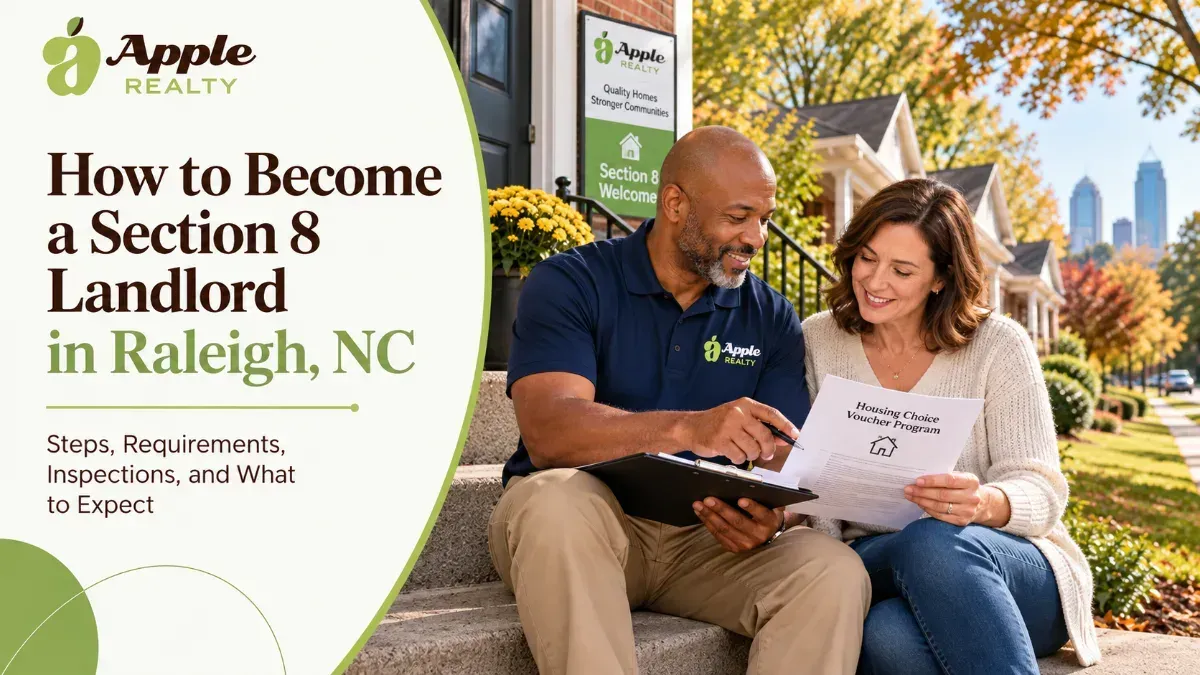
If you want the short version of how to become a Section 8 landlord in Raleigh, here is the whole sequence: advertise that you accept vouchers, screen and approve a voucher holder yourself, have the family submit a Request for Tenancy Approval (RFTA) to the housing authority, complete the owner application packet (owner's application, proof of ownership, W-9 and direct deposit form), pass the unit inspection, clear the rent reasonableness review, sign a one-year lease with the tenant, and then sign a Housing Assistance Payments (HAP) contract with the agency. Payments follow by direct deposit, retroactive to the contract's effective date. That is it — no license, no separate certification, no fee.
What that summary hides is the timing, the rent caps and the inspection standard. This guide walks through each of those for Raleigh and Wake County owners, current as of September 2026.
Voucher program figures and procedures are set locally by each housing authority and change every year. Payment standards, fair market rents and inspection scheduling all reset annually. Confirm current numbers with the agency that will administer your contract before you price a unit.
Who actually administers vouchers in Raleigh and Wake County
The HUD Housing Choice Voucher program is federally funded but locally run. HUD sends money to public housing agencies (PHAs), and the PHA writes the contract with you. In this market there are two you may end up dealing with.
Raleigh Housing Authority (RHA) is the larger of the two and states that it administers the program in Wake County. Its owner onboarding is documented step by step on the Raleigh Housing Authority landlord application page, and its Leased Housing office is at 900 Haynes Street in Raleigh.
Wake County Housing Authority (WCHA), based in Zebulon, administers a smaller voucher portfolio across Apex, Cary, Fuquay-Varina, Garner, Holly Springs, Knightdale, Morrisville, Raleigh, Rolesville, Wake Forest, Wendell and Zebulon. Its process is summarized on the Wake County Housing Authority landlord page, and it points owners to GoSection8 for free listings.
You do not choose the agency — the tenant does, because the voucher is issued by whichever PHA the family is enrolled with, and a family that ported in from elsewhere may bring a third agency into the mix.
"Which housing authority issued your voucher, and what is your bedroom size and payment standard?" Those three data points tell you within thirty seconds whether the unit is plausibly in range — before you spend a Saturday on a showing.
The step-by-step: from listing to first HAP payment
- Advertise that you accept vouchers. RHA suggests listing on its own property listings page, NC Housing Search, AffordableHousing.com, NCHFA or general classifieds. WCHA points owners to GoSection8. Neither agency steers families to specific owners, so your listing has to do the work.
- Screen the applicant yourself. The agency determines program eligibility. It does not determine whether someone is a good tenant. RHA runs criminal background checks on participants but explicitly does not run credit checks or pull rental histories, so credit, rental references and income verification are on you — applied uniformly to every applicant.
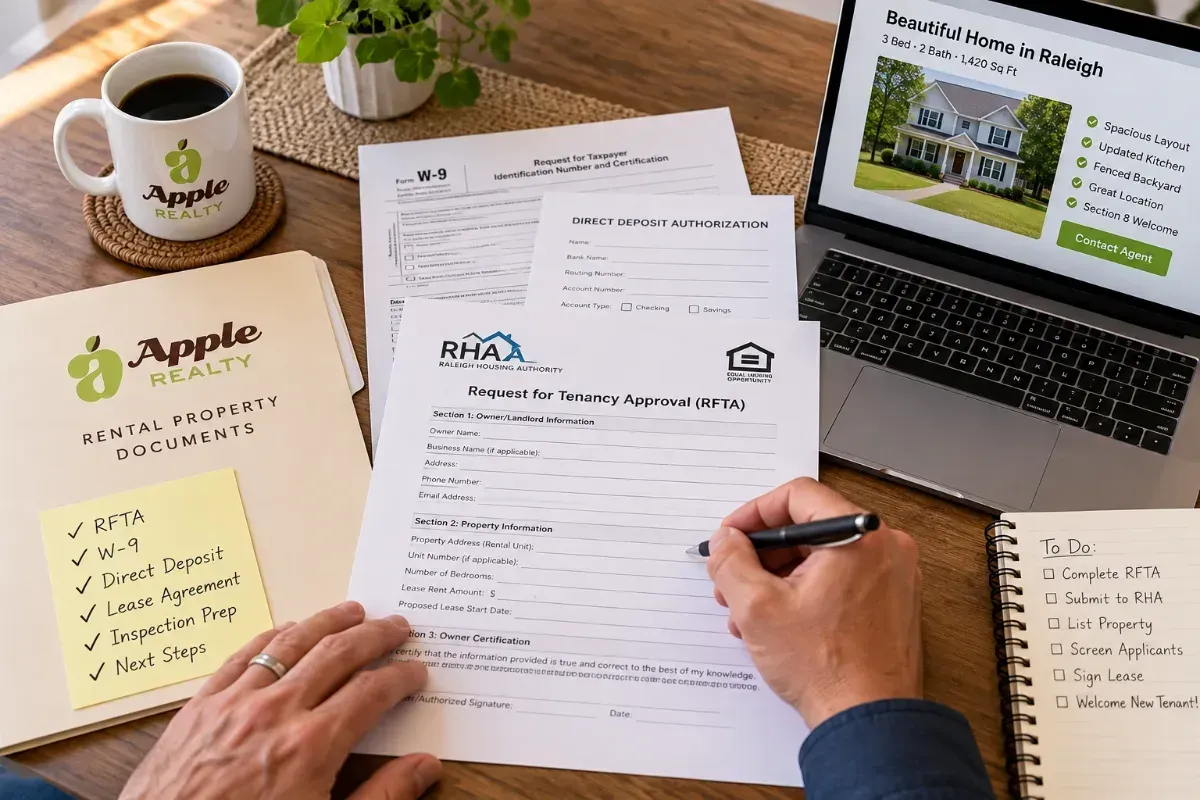
- Receive and complete the RFTA. Once you approve the family, they hand you the Request for Tenancy Approval packet. You fill in the unit details, the rent you are asking and which utilities the tenant pays. The family submits it to the agency. Submitting the RFTA is the formal signal that you have approved the tenant.
- Submit the owner packet. After the RFTA is in, complete the owner's application, provide proof of ownership, a W-9, a direct deposit authorization with bank documentation, and a management company notification form if a manager will handle the property. RHA runs a criminal background check on first-time participating owners. Note the ordering: owner applications are accepted only after an RFTA has been submitted for a specific tenant and unit.
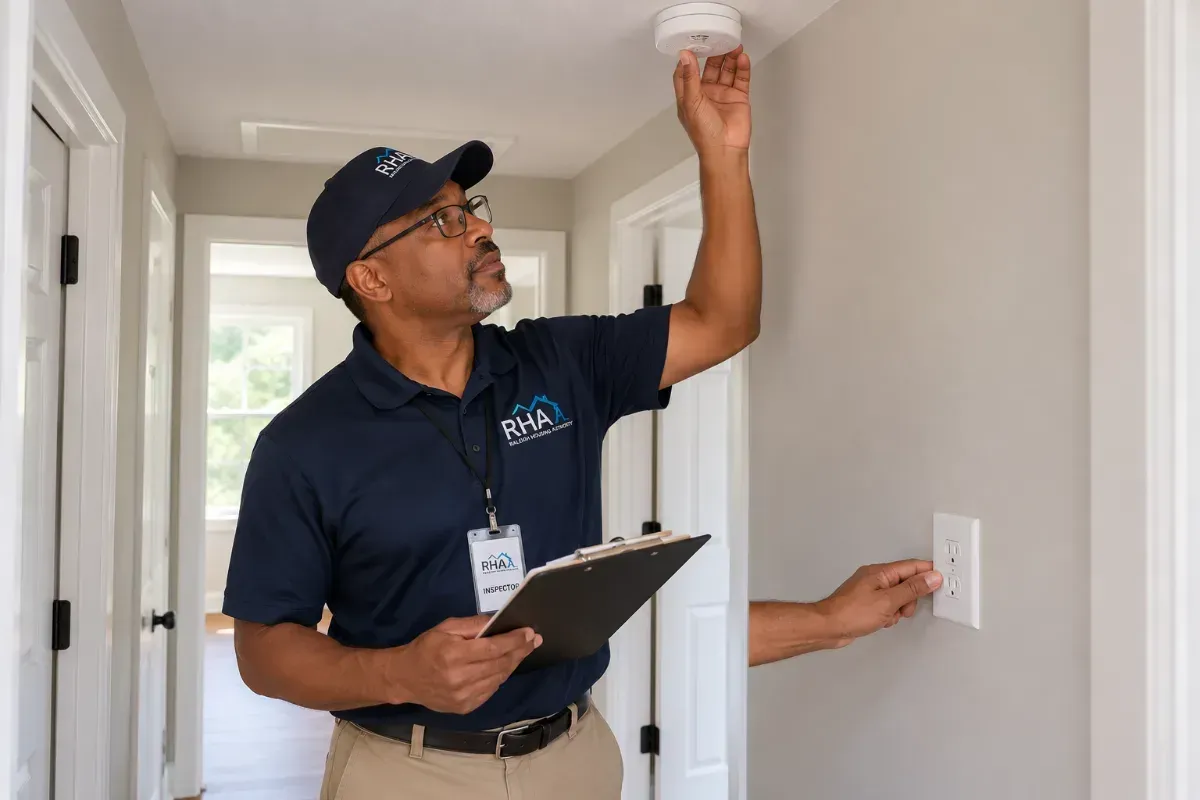
- Pass the inspection. The agency schedules a move-in inspection. Utilities must be on and the range and refrigerator must be installed, or the inspection is a wasted trip.
- Clear rent reasonableness. Separately from the inspection, the agency compares your requested rent to unassisted comparables. You are contacted directly if the rent is deemed unreasonable.
- Sign the lease. Only after the unit passes inspection and the rent is approved may the tenant sign and move in. The initial lease term must be at least one year, and a copy goes to the agency. If a tenant moves in before the unit passes, the tenant is solely responsible for the full contract rent — a genuinely expensive mistake.
- Execute the HAP contract and get paid. The HAP contract between you and the agency is executed within approximately four to eight weeks of move-in. Its effective date is the later of the lease start date or the passed-inspection date, and the agency pays its portion retroactively to that date. After that, HAP payments arrive by direct deposit on the first business day of each month.
What you actually get paid: payment standard vs. fair market rent
This is where most owners misjudge the program. Two separate limits apply, and the lower one wins.
The payment standard is the maximum the agency will use to calculate its subsidy for a given bedroom size. Under federal rules, a PHA sets its payment standard within a "basic range" of 90% to 110% of HUD's published Fair Market Rent (FMR) for the area, without needing HUD approval. It can go above 110% only by qualifying for an exception.
The FMR is HUD's annual estimate for the metro area. Raleigh sits in the Raleigh-Cary, NC MSA, which covers Wake, Johnston and Franklin counties. You can pull the source figures yourself from HUD's Fair Market Rent data.
Fair Market Rents, Raleigh-Cary, NC MSA (FY 2027)
Effective October 1, 2026. Source: HUD FY 2027 county-level FMR file, published September 1, 2026.
| Unit size | FY 2027 FMR | 90% of FMR | 110% of FMR |
|---|---|---|---|
| Efficiency (0 BR) | $1,489 | $1,340 | $1,638 |
| 1 bedroom | $1,552 | $1,397 | $1,707 |
| 2 bedrooms | $1,689 | $1,520 | $1,858 |
| 3 bedrooms | $2,103 | $1,893 | $2,313 |
| 4 bedrooms | $2,823 | $2,541 | $3,105 |
Two cautions. The FMR is a gross rent figure covering rent plus tenant-paid utilities, so where the tenant pays electricity and gas a utility allowance is deducted and the rent you collect is lower than the headline number. And the payment standard is a ceiling used in a formula, not a guaranteed rent.
Rent reasonableness can cap you below the payment standard
Even when your asking rent fits comfortably under the payment standard, the agency must separately determine that the rent is reasonable. It does this by comparing your unit to similar unassisted units on the open market — size, age, amenities, condition and location. If comparable market units rent for less than you are asking, the agency will not approve your number, and the unit is not approved for leasing until both tests pass.
The practical effect: Section 8 does not let you charge above-market rent. What it offers instead is a large, motivated applicant pool and a reliably paid subsidy portion.
The single most costly error in this process is handing over keys before the unit has passed inspection and the rent has been approved. If that happens, the housing authority owes you nothing and the tenant is personally liable for the entire contract rent — which, for a voucher household, is usually uncollectable.
The inspection: HQS, NSPIRE and what gets checked
HUD has been moving the voucher program from Housing Quality Standards (HQS) to the newer NSPIRE framework, which replaces HQS's short judgment-based checklist with roughly seventy published standards sorted into severity tiers. That transition is not finished. HUD published HUD's NSPIRE compliance date extension on September 30, 2025, pushing the compliance date for the Housing Choice Voucher, Project-Based Voucher and Moderate Rehabilitation programs to February 1, 2027.
So as of September 2026, agencies may still inspect to HQS, and Raleigh Housing Authority's inspections division describes its work in HQS terms while also publishing an NSPIRE standards guide for owners. Assume you will be inspected under HQS this year and under NSPIRE shortly after — and prepare to the stricter standard.
Inspection cadence in Raleigh: an initial move-in inspection before the HAP contract is signed, then a renewal inspection required before twelve months from the last inspection, plus complaint or special inspections on request and periodic quality-control re-inspections of a sample of the portfolio.
Inspection-readiness checklist
- Electricity, gas and water on in the owner's name for the inspection date
- Range and refrigerator installed and working
- Working smoke alarms on every level and outside sleeping areas; carbon monoxide alarm where required
- No exposed wiring, missing outlet or switch covers, or open junction boxes
- GFCI protection near sinks and in wet areas
- Every window that is meant to open, opens — and every window lock works
- Handrails on any stairway with four or more risers; secure guardrails
- Hot water heater with a proper temperature and pressure relief valve and discharge pipe
- No peeling or chipping paint, especially in pre-1978 housing (lead-based paint rules apply)
- No plumbing leaks, no standing water, no visible mold; working ventilation in bathrooms
- Sound flooring, no trip hazards, no broken glass
- Working locks on all exterior doors and a usable second means of egress
- Yard free of debris; no pest infestation
Do you have to accept vouchers in North Carolina?
No — and this is the point most national articles get wrong for this state.
North Carolina has no statewide source-of-income protection. The State Fair Housing Act at Chapter 41A prohibits housing discrimination on the basis of race, color, religion, sex, national origin, handicapping condition and familial status. Source of income is not on that list.
More than that, state law affirmatively preempts local ordinances that would create such a protection. N.C. Gen. Stat. 42-14.1, as amended by Session Law 2024-47, provides at subsection (b) that no county or city may enact, maintain or enforce any ordinance or resolution prohibiting an owner from refusing to rent to a person because that person's lawful source of income to pay rent includes funding from a federal housing assistance program. Narrow carve-outs remain for property the local government itself owns, for agreements it enters into voluntarily, for CDBG-assisted properties, and for owners who receive funding or financial incentives from the county or city.
Translation for a Raleigh owner: participation in the voucher program is voluntary, unless you have taken local funding or incentives that came with strings attached. This is general information rather than legal advice — if your property has received any public subsidy, have counsel check your obligations.
The honest pros and cons
In favor:
- The subsidy portion is paid directly to you by a government agency on the first business day of each month, by direct deposit. That is the most reliable rent line item most owners will ever have.
- The applicant pool is large and motivated, and voucher holders have a strong incentive to keep the tenancy in good standing because losing it means losing the voucher.
- Tenancies tend to run long, which lowers turnover cost — usually the largest hidden expense in a single-family rental.
- Annual inspections force a maintenance discipline that protects the asset.
Against:
- Lease-up is slower. Between the RFTA, the owner packet, the inspection, the rent review and the four-to-eight-week HAP processing window, you are looking at weeks of vacancy a market tenancy would not cost you.
- Rent is capped twice — by the payment standard and again by rent reasonableness — so you cannot price above market, and you may end up slightly below it.
- Administrative overhead is real: annual inspections, re-inspection scheduling, recertification paperwork, and correspondence every time the payment split moves.
- The tenant's portion is still collected by you, and it is not guaranteed by anyone. Deposits are not funded by the agency, and you may not charge a voucher tenant more than you charge unassisted tenants.
Vouchers pencil best on solid, well-maintained older three- and four-bedroom houses where market rent sits at or just below the payment standard. They pencil worst on newer premium units.
Making the decision
If your unit is in good repair, priced in line with the market and you can absorb a slower lease-up, the voucher program is a defensible way to fill a vacancy with a long-tenured resident and a government-backed rent portion. If you need the unit occupied in ten days or you are counting on a premium rent, it is the wrong tool.
The deciding factors are local: the issuing agency's payment standard, your submarket comparables, and your unit's condition against the inspection standard. We track all three across Wake County as part of day-to-day Raleigh property management, and handle the same questions across the Triangle through our Durham property management team. Owners can review our owner services, and prospective residents will find our resources for renters useful.
Apple Realty manages single-family and small multifamily rentals across Raleigh and Wake County, including voucher-assisted tenancies. We will price your unit against the current payment standard, tell you whether it clears rent reasonableness, prep it for inspection and handle the RFTA, HAP contract and annual recertifications. Contact us for a free rental analysis.
Frequently Asked Questions
How do I become a Section 8 landlord in Raleigh?
Advertise that you accept vouchers, screen and approve a voucher holder yourself, then have the family submit a Request for Tenancy Approval (RFTA) to the housing authority. You complete an owner application, W-9, direct deposit form and proof of ownership. The agency inspects the unit and runs a rent reasonableness check, you sign a one-year lease with the tenant, and the agency signs a HAP contract with you.
Do landlords in North Carolina have to accept Section 8 vouchers?
No. North Carolina has no statewide source-of-income protection, and the State Fair Housing Act (Chapter 41A) does not list source of income as a protected class. N.C. Gen. Stat. § 42-14.1(b) goes further and bars any county or city from enacting or enforcing an ordinance that would stop an owner from refusing to rent because the tenant's lawful income includes federal housing assistance. Participation is voluntary.
How much rent will Section 8 pay in Raleigh?
It depends on the housing authority's payment standard and on rent reasonableness — not on what you ask for. Payment standards are normally set between 90% and 110% of HUD's Fair Market Rent for the area. For the Raleigh-Cary, NC MSA, the FY 2027 two-bedroom FMR is $1,689, effective October 1, 2026, which puts the ordinary payment standard range at roughly $1,520 to $1,858.
What is rent reasonableness and can it lower my rent?
Yes. Rent reasonableness is a separate test in which the agency compares your unit to similar unassisted units on the open market by size, age, amenities and location. Even if your asking rent sits under the payment standard, the agency can refuse to approve it if comparable unassisted units rent for less. The unit is not approved until it passes inspection and the rent is deemed reasonable.
Is the Section 8 inspection still HQS or is it NSPIRE now?
As of September 2026 the voucher program is still in transition. HUD extended the NSPIRE compliance date for the Housing Choice Voucher program to February 1, 2027, so agencies may continue to use Housing Quality Standards (HQS) until then. Raleigh Housing Authority currently inspects to HQS and publishes an NSPIRE standards guide for owners. Expect an initial inspection and then an inspection at least every 12 months.
When do I get my first HAP payment?
Not on move-in day. At Raleigh Housing Authority the HAP contract is executed within roughly four to eight weeks after the tenant moves in, and the agency then pays retroactively back to the contract's effective date — the later of the lease start date or the passed-inspection date. Ongoing HAP payments arrive by direct deposit on the first business day of each month.
What happens if my tenant's income goes up or down?
The total rent stays the same, but the split changes. The agency recalculates the family's share and adjusts its housing assistance payment accordingly. If the tenant's income rises, your HAP deposit shrinks and the tenant owes more directly to you; if income falls, the HAP portion grows. You are notified in writing before the split changes.
Can I still screen, charge a deposit and evict normally?
Yes. The housing authority determines program eligibility, not tenancy suitability — you run your own credit, criminal and rental-history screening using the same non-discriminatory criteria you apply to everyone. You may collect a security deposit, but not more than you charge unassisted tenants, and the agency does not fund deposits. Lease enforcement and eviction follow North Carolina landlord-tenant law.