How Much Rent Can You Afford? The 30% Rule, a Simple Formula & a Durham Reality Check

The 30% rule, explained
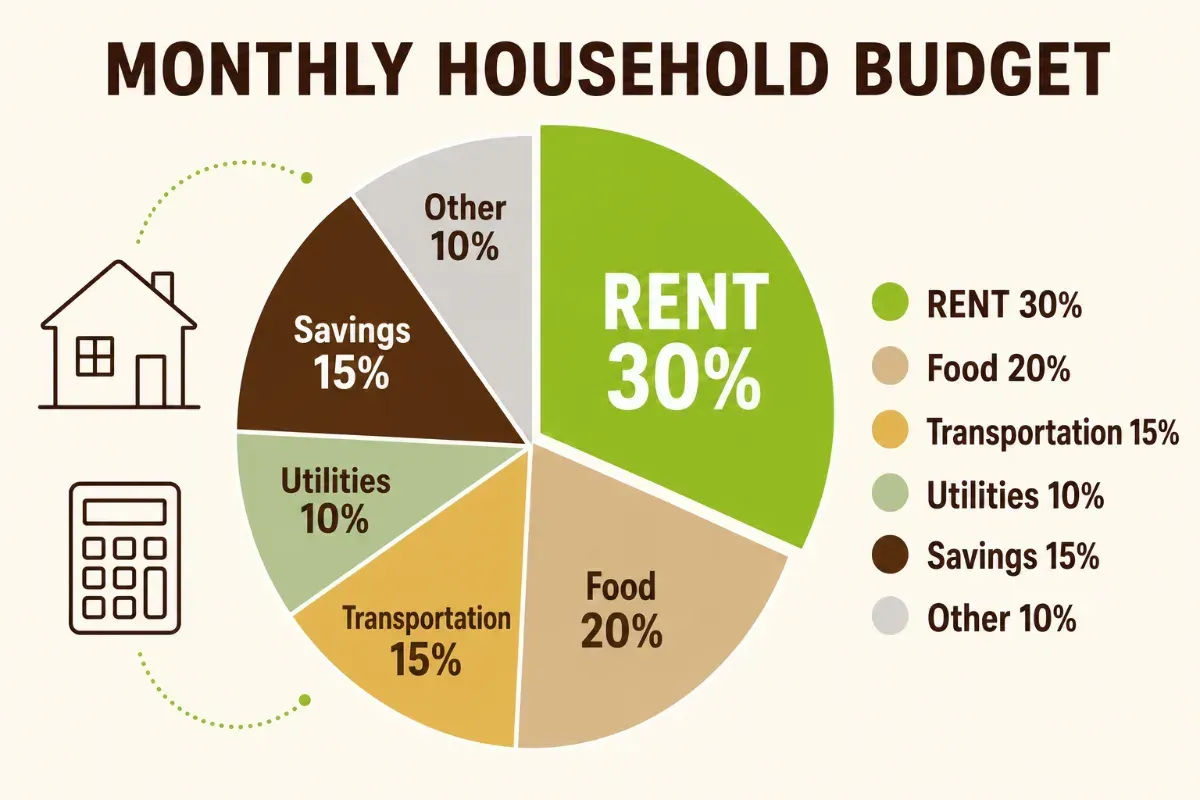
The most widely used rule of thumb is simple: spend no more than 30% of your gross (pre-tax) monthly income on rent.
Why 30%? It's the long-standing benchmark for housing affordability - stay at or below it and you generally have enough left for savings, debt payments, transportation and everyday life. Cross well above it and you become "cost-burdened," the term for households spending more than 30% of income on housing.
To find your number, multiply your gross monthly income by 0.30:
- $4,000/month income x 0.30 = $1,200 rent
- $5,000/month income x 0.30 = $1,500 rent
- $6,500/month income x 0.30 = $1,950 rent
A worked example
Say you earn $66,000 a year. Here's the full calculation:
- Gross monthly income: $66,000 ÷ 12 = $5,500
- Apply the 30% rule: $5,500 x 0.30 = $1,650
- Your target rent ceiling: about $1,650/month
Now sanity-check it against take-home pay. If taxes and deductions leave you with roughly $4,300/month, that $1,650 rent is about 38% of net income- workable, but on the higher side if you also carry a car payment or student loans. This is why the smartest renters look at both gross and net.
Rent-to-income ratio and the landlord's 3x rule
The 30% rule looks at affordability from your side. Landlords look at it from the other direction with the 3x rule: many require that your gross income be at least three times the monthly rent to qualify. Those two guidelines are really the same math - 3x rent means rent is about one-third of income.
So if a Durham home rents for $1,600/month, expect to show income around $4,800/month(roughly $57,600/year) to qualify on your own. Renting with roommates changes the picture: you split both the rent and the income requirement, which is how many renters afford homes in higher-demand neighborhoods. Review our application and screening requirements so you know what to expect before you apply.
A Durham reality check
Rules of thumb are only useful against real prices. Durham and the wider Triangle have seen steady rent growth as Duke, UNC and a booming Research Triangle Park job market draw new residents. Rents vary widely by neighborhood, size and how close you are to downtown or the universities, so the same budget stretches differently across the city.
Use your 30% number as a filter, then map it to actual listings:
- If your ceiling is $1,200, you'll focus on smaller units, roommates, or areas farther from the downtown/campus core.
- Around $1,500-$1,800, more one- and two-bedroom options in established neighborhoods open up.
- Above $2,000, you'll reach newer or larger homes and prime locations.
Browsing current Durham rental listings against your target number turns an abstract budget into a realistic shortlist - and stops you from touring homes you'll love but can't comfortably afford.
Don't forget the costs beyond rent
Rent is only part of your true housing cost. Before you commit, add:
- Utilities not included - electricity, gas, water, internet
- Security deposit(often one month's rent) and any application or pet fees
- Renters insurance, usually inexpensive but often required
- Parking or a transit pass
- Commuting costs to work or campus
When it's smart to bend the rule
The 30% rule is a guideline, not a law. It can make sense to go slightly higher if you have little or no debt, stable income and strong savings, or if a pricier home cuts a long commute enough to save real money and time. It makes sense to stay well below 30% if you're paying down debt, building an emergency fund, or expecting your income to dip. The point isn't to hit exactly 30% - it's to choose a number you can sustain without stress. For more on building a realistic budget, the Consumer Financial Protection Bureau budgeting guidance offers free tools.
Find a home that fits your number
Once you know your rent ceiling, the search gets simpler and less stressful: you're comparing homes you can actually afford instead of falling for ones you can't. Run the 30% math, check it against your take-home pay, factor in the extras, and set a number with a little breathing room.
Frequently Asked Questions
How much rent can I afford on my salary?
A common starting point is the 30% rule: spend no more than 30% of your gross (pre-tax) monthly income on rent. On a $60,000 salary, that's about $1,500 a month. It's a guideline, not a law - your other debts and expenses may push the right number higher or lower.
What is the 30% rule for rent?
The 30% rule says housing costs should stay at or below 30% of your gross monthly income. Landlords often use a related standard from the other direction, requiring that your income be about 3x the monthly rent to qualify for a lease.
What is a good rent-to-income ratio?
A rent-to-income ratio of 30% or less is generally considered healthy. Above 30% you're 'cost-burdened,' meaning rent may crowd out savings, debt payments and emergencies. Some renters in higher-cost areas go higher, but the more room you leave, the safer your budget.
Should rent be based on gross or net income?
The 30% rule uses gross (pre-tax) income because that's what landlords screen against. But for your own budget, it's smart to also check rent against your take-home pay- aim for roughly 35-40% of net income or less - so the number is realistic after taxes.
How much do I need to earn to rent in Durham, NC?
It depends on the home, but because many landlords require income of about 3x the rent, a $1,600/month Durham apartment typically calls for roughly $4,800/month(about $57,600/year) in gross income. Roommates split both the rent and the income requirement.